

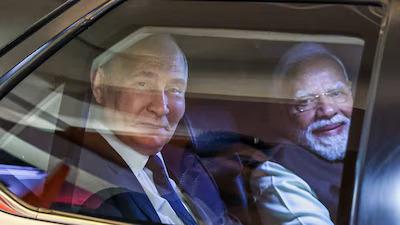
Why Modi and Putin Chose a Toyota Fortuner Instead of an Armoured SUV | Full Exclusive Report
During Russian President Vladimir Putin’s recent visit to India, one moment captured global attention: Prime Minister Narendra Modi personally received Putin at Delhi’s Palam Technical Area and then both leaders travelled together in a white Toyota Fortuner instead of the usual heavily armoured state limousines.
The visuals instantly went viral, sparking curiosity, discussions, and political interpretations. Why did India and Russia opt for a relatively simple, civilian-looking SUV instead of the elite armoured vehicles typically used for heads of state?
This long-form exclusive explains the full background, the strategic reasons, the security logic, and the diplomatic signalling behind the unusual yet powerful choice.
A Moment That Broke Protocol
Under standard diplomatic protocol, visiting world leaders—especially those under high threat levels—travel only in:
Armoured BMW 7 Series
Mercedes Maybach S600 Guard
Range Rover Sentinel
Russia’s Aurus Senat limousine
However, just minutes after Putin stepped off his aircraft, Prime Minister Modi escorted him directly to a Toyota Fortuner parked on the tarmac. Both leaders sat together in the middle row and travelled unescorted by the usual massive motorcade.
It was a surprising deviation from traditional VIP movement patterns and instantly generated global buzz.
Why a Toyota Fortuner? Key Reasons Explained
Below are the major strategic, security, diplomatic, and symbolic reasons behind this high-profile decision.
1. Low-Profile Movement for High Security
Although the Fortuner is a common SUV in India, this specific unit was reportedly part of a security-agency fleet, specially modified with:
Run-flat tyres
Reinforced body panels
Enhanced braking systems
Communication interception protection
Hidden armour inserts
A less “VIP-looking” vehicle allows security teams to:
Avoid predictable movement patterns
Reduce visibility of high-value targets
Minimize risk of long-range attacks
Blend into civilian traffic more easily
In today’s global threat scenario, being less noticeable is sometimes safer than being heavily armoured.
2. Practicality Over Prestige
Unlike fully armoured European limousines, the Toyota Fortuner offers:
Higher ground clearance
Better visibility
More flexible seating
Faster ingress & exit
Easily maneuverable in narrow or crowded areas
For short-distance travel within controlled zones (like airport to residence), a broad, comfortable SUV is more practical than a long, heavily armoured luxury sedan.
Officials indicated that the Fortuner provided enough space to seat:
The two leaders
An interpreter
A senior protocol officer
Standard armoured limos often do not offer this flexibility.
3. A Diplomatic Signal to the West
Strategic analysts see the choice of a Japanese-origin SUV as symbolic geopolitical messaging.
During a time when major Western powers maintain sanctions on Russia, using a European luxury car (like BMW, Mercedes, or Range Rover) could send the wrong signal.
By choosing a non-Western, Asian-manufactured vehicle:
India avoids triggering diplomatic sensitivity
Russia sidesteps Western optics
Both nations highlight independent strategic alignment
The Fortuner ride subtly showcased the message:
“India makes its own decisions — not influenced by Western symbolism.”
4. Strong Personal Chemistry Between Modi and Putin
Modi and Putin share one of the warmest personal rapports among global leaders. Their previous informal moments include:
Riding in a golf cart
Sharing a boat ride
Walking through parks without heavy protocol
Visiting temples together
The Fortuner ride fits this pattern — it was a demonstration of relaxed, personal camaraderie rather than rigid diplomatic formality.
This moment symbolised:
Trust
Comfort
Friendship
A message of unity between the two leaders
Such gestures carry strong diplomatic weight.
5. Quick, Silent, Efficient Movement
Airport-to-residence movements are usually highly sensitive. The Fortuner allowed:
Faster deployment
Easier route adjustments
Lower noise signature
Minimal public attention
Instead of an extravagant convoy, the Fortuner created a controlled, efficient transit suitable for top-tier leaders in high-security situations.
The Fortuner: Not “Normal” — Likely Specially Upgraded
Though it appeared like a regular SUV, the vehicle used was likely:
Special Security Modified
Bullet-resistant glass
Reinforced floor panels
Satellite communication
Counter-surveillance equipment
Emergency breathing apparatus
Part of a Government Fleet
These units are maintained and vetted by:
SPG (Special Protection Group)
NSG Security Wing
Intelligence Bureau Vehicle Unit
They undergo routine checks before being used for VIP movement.
So, even though the Fortuner “looked normal”, it was far from ordinary.
The Symbolism: What the Fortuner Ride Really Meant
Here is what global observers believe the moment signified:
India–Russia partnership remains strong
Despite global realignments, Modi’s personal escort gesture was a powerful message of respect for Russia.
India prefers pragmatic, non-Western optics
Choosing a Japanese SUV over a European armoured limo subtly avoided political baggage.
Modi and Putin share a warm personal connection
Leaders who trust each other do not need ceremonial separation.
India’s diplomacy blends simplicity with strategy
The Fortuner embodied practicality, security, and symbolism all at once.
Conclusion: A Simple Car Ride, A Powerful Diplomatic Statement
The Toyota Fortuner moment was more than just a vehicle choice. It represented:
Strategic security
Diplomatic signalling
Geopolitical sensitivity
Personal warmth between leaders
India’s independent global posture
Sometimes, the most unexpected decisions — like two world leaders sitting in a modest white SUV — create the strongest political messages.
Leave a comment
Your email address will not be published. Required fields are marked *